Donate
The Science Behind It All
What does it take to turn a heavily altered landscape into a productive ecosystem? At the Cuyama sites, we’re learning that there’s no single answer. Transformation is an experiment: by carefully monitoring what happens, we can learn which approaches help native plants establish, which conditions matter most, and how those early successes translate into long-term survival.
Over the past year, Santa Barbara Botanic Garden and collaborators at Quail Springs have collected data across three transformation sites in the Cuyama Valley. Together, we’re tracking plant survival, biomass, and native and non-native plant cover while testing different approaches to transformation. We’re asking practical questions that can help guide future transformation efforts: Is weeding worth the effort? Is planting more effective than simply removing weeds? Does mulch make a difference? And how important is water for getting native plants established? While the work is still underway, some answers are already beginning to emerge.
Some Plants Do Better Than Others
One of the things we’re learning from our survival and biomass data- biomass being the amount of above-ground living material growing per plant- is that not all plants respond the same way to transformation. Some species establish and grow much more successfully than others, even when they’re planted under the same conditions.
That matters because transformation success isn’t just about how many native plants we put in the ground. We also want to understand which species are most likely to survive, which produce the most biomass, and which can contribute to a functioning plant community over time.
These differences between species are part of what makes transformation a long-term experiment. A plant that looks successful during its first season may not be the one that persists in the next year. Continuing to track survival and growth will help us understand which early successes are durable.
We’ve already seen some clear standouts: Prince’s plume (Stanleya pinnata), California aster (Corethrogyne filaginifolia), and cobweb thistle (Cirsium occidentale) all survived and grew beautifully. Others, like black sage (Salvia mellifera), struggled to establish, with none of the plants we added surviving into the summer.
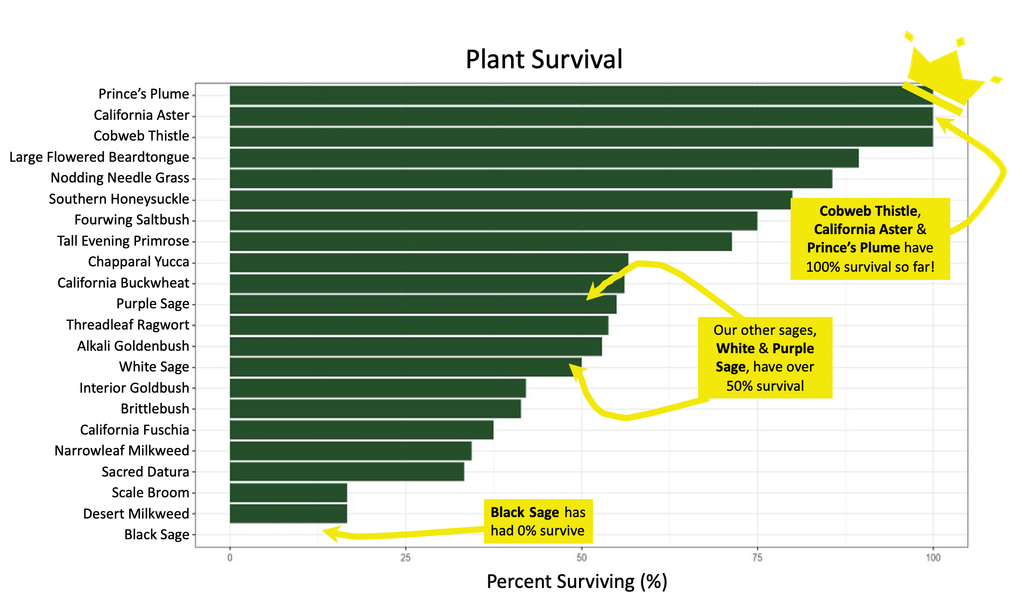
through summer 2026. The good news? Every Prince’s Plume (Stanleya pinnata) we planted made it through
the summer. At the other end of the spectrum, none of the Black Sage (Salvia mellifera) plants survived through spring.
These differences between species give us a helpful glimpse into which plants are thriving in the Cuyama Valley,
and which may need a little more support as the transformation continues.
Each Site Tells a Slightly Different Story
While our survival and biomass data reveal differences among plant species, our plant-cover data reveal some clear site-specific lessons.
At one of our sites, Cuyama Homegrown, we wanted to know whether actively removing non-native plants could help create better conditions for native species. It did.
In plots where we actively weeded, non-native plant cover decreased from 100% (blue bar shown below) to about 80% (yellow bar shown below). But the biggest change occurred where we combined weeding with planting. There, non-native plant cover dropped to around 50% (grey bar shown below).
That suggests that simply removing weeds may not be enough. When open space is created, non-native plants can quickly return unless native plants are also there to occupy that space.
In other words, transformation isn’t just about taking something away. Removing competition and adding native plants together can help shift the trajectory of a highly disturbed site.
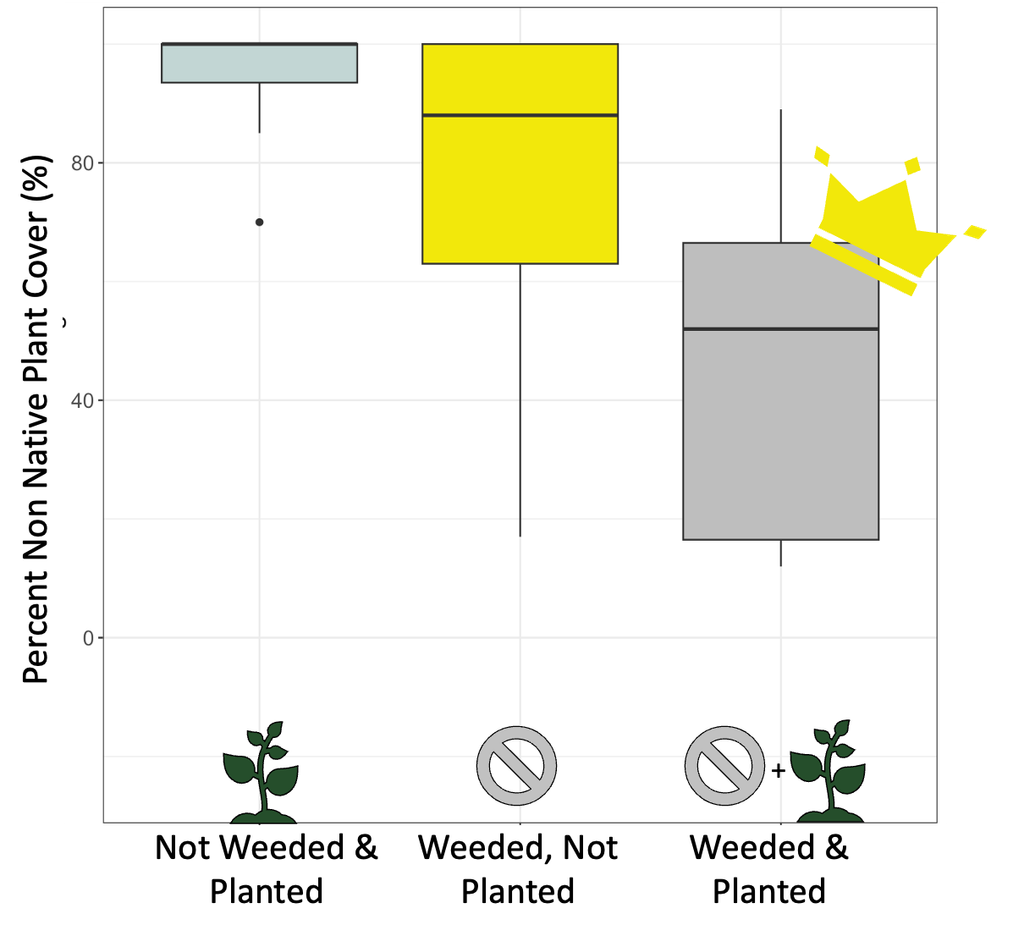
This graph shows how much of the Cuyama Home Grown site was covered by non-native plants
under three different approaches. In one area, we planted native plants without removing
the existing weeds (blue bar). In another, we removed the weeds but left the area unplanted
to see what would grow on its own (yellow bar). In the third, we did both: removed the weeds
and planted native species. Of the three approaches, combining weeding and planting led to
the biggest reduction in non-native vegetation (grey bar).
This gives us a useful clue about how to make the most of our transformation efforts.
At another site, River-side Ranch, we tested two strategies for reducing weed cover: ‘regular mulching’ and ‘sheet mulching’. For sheet mulching, instead of placing wood chips directly on the soil, we added a layer of cardboard first and then covered it with wood chips. The difference was striking.
Regular mulching reduced non-native plant cover, but sheet mulching performed even better. Adding cardboard beneath the wood chips reduced non-native cover from roughly 30% (blue bar below) to just 10–15% (yellow bar below).
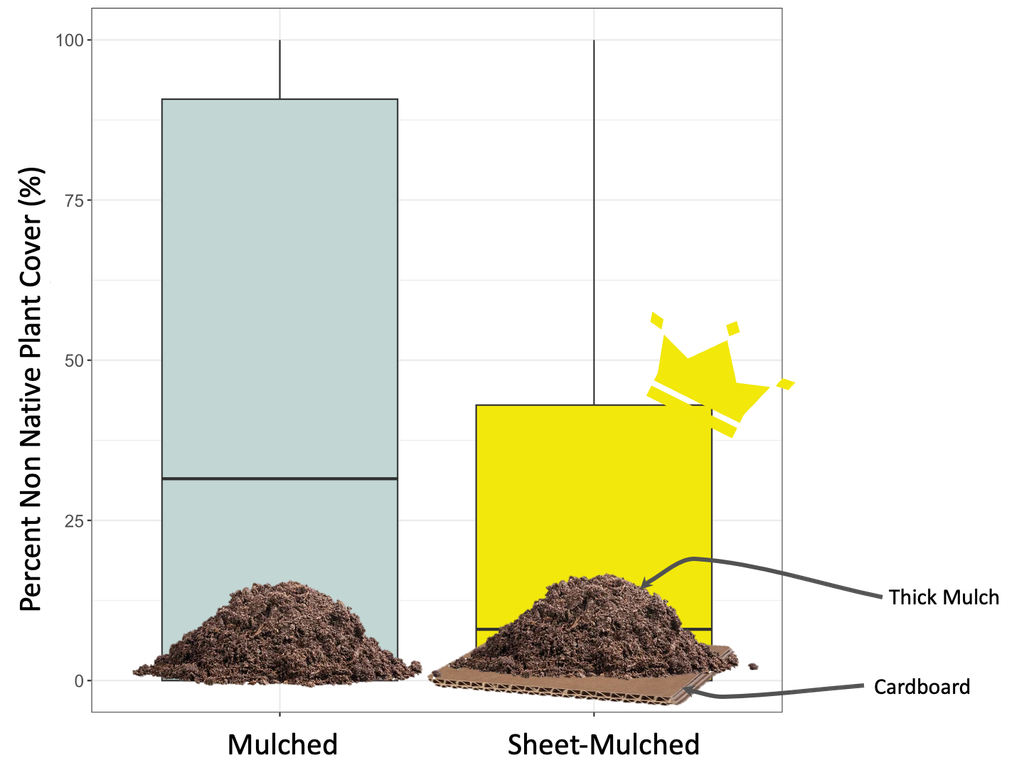
traditional mulching (blue bar), where a layer of mulch was applied to the soil, and sheet mulching,
which uses a layer of material to smother existing vegetation before adding mulch on top (yellow bar).
This graph shows the amount of non-native plant cover under each treatment.
Sheet mulching resulted in less non-native vegetation, suggesting that it may be a
particularly effective tool for giving native plants a head start.
It’s a relatively simple intervention, but this is exactly why monitoring is useful. Two approaches that might look similar on the ground can have very different outcomes once we measure them.
At our third site, Condor’s Hope, we tested three transformation approaches: direct seeding, planting container-grown plants, and leaving plots fallow. Very surprisingly, we didn’t see much difference among the three treatments. Native plant cover remained low, while non-native plant cover remained relatively high.
There was one important thing that all the treatments at Condor’s Hope had in common: none of the plots were watered.
That observation becomes even more interesting when we look across our three transformation sites.
Across Sites, Water Is the Driver
When we compare our sites, one of the clearest patterns in our plant-cover data is the importance of water. Across treatments, watering had the strongest effect we’ve seen so far, increasing native plant cover by roughly five times.
And we see a similar pattern in our other measurements: water is also emerging as a major driver of plant survival and biomass.
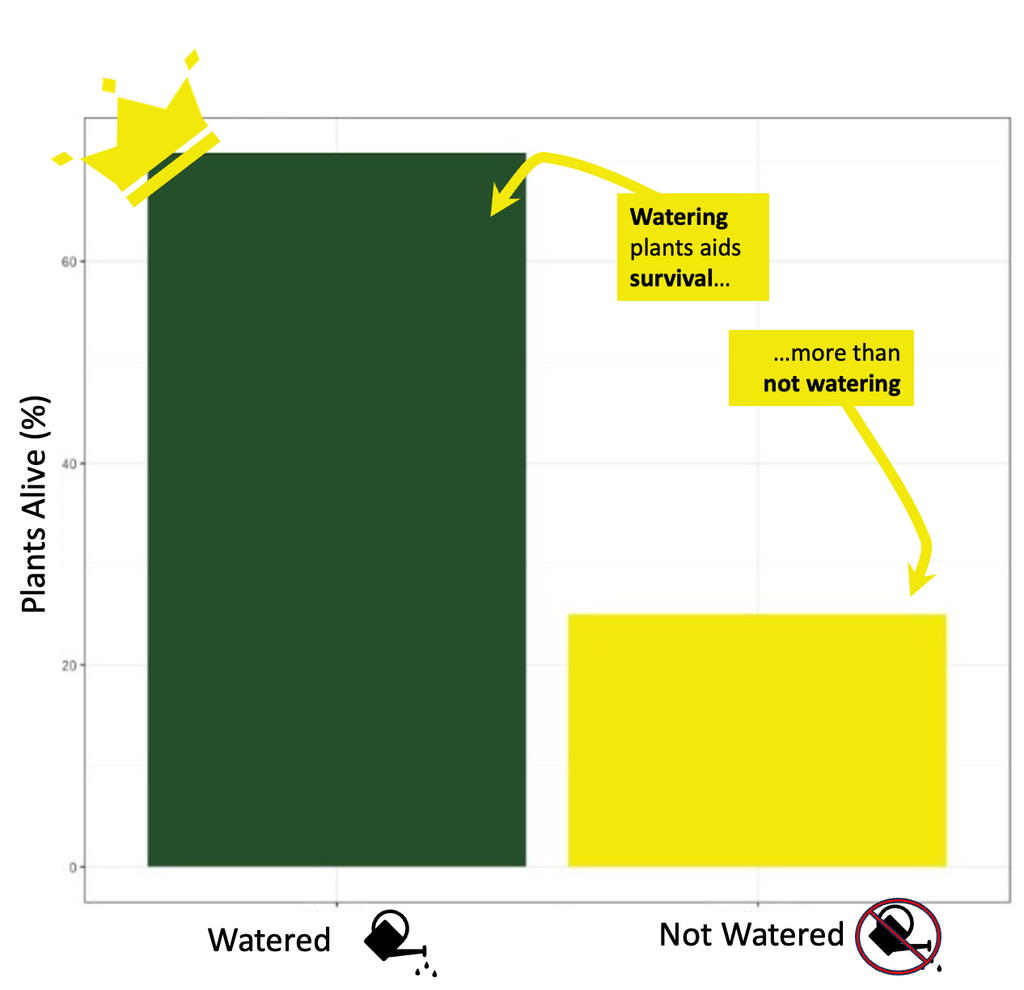
Across all three transformation sites, we compared plants that received supplemental
watering with those left to rely on natural rainfall. The difference was striking: watered plants
had much higher survival than unwatered plants. This result highlights how important
supplemental water can be for helping native plants get established in the Cuyama Valley’s
dry landscape and gives us a clearer picture of where and when watering may be worth the effort.
This may not be surprising – plants need water to grow – but seeing that relationship emerge from our field data is important. Transformation happens with limited time, money, and resources. If we know which interventions have the greatest impact, we can make better decisions about where to invest those resources.
For establishing native plants in the Cuyama Valley, our early data suggest that water can make a substantial difference.
But that raises another question: what happens when the water stops?
Establishment Is Only the Beginning
Our goal isn’t to create a plant community that depends on regular irrigation. These are native plants being established in a dry landscape, and long-term transformation success means that plants ultimately need to persist under the conditions they’ll experience in the landscape.
That’s why survival through the first year is only part of the story.
A plant that survives with supplemental water may respond very differently once irrigation is reduced or removed. Likewise, a plant that grows quickly during its first season may not necessarily be the one that survives over the long term.
Our next phase of monitoring will help us answer those questions. We’ll continue tracking which plants survive, how much they grow, and how their communities develop as conditions change.
What We’ve Learned So Far
At this stage, a few lessons are emerging.
Plant choice matters. Weed pressure matters. Planting matters. The way we mulch matters. And, perhaps most importantly, water matters.
But the bigger lesson is that transformation isn’t a single intervention with a guaranteed outcome. Different approaches work differently depending on the site, the species, and the conditions.
For now, our data suggest that the early recipe for establishing native plants is fairly straightforward: reduce competition, add native plants, and provide enough water to give them a chance to establish.
The more interesting question is what happens next?
Are the plants that survive their first year actually able to persist? Which species continue to grow and produce biomass? Which plants become the foundation of a diverse community? And, ultimately, do these young plant communities begin to support more of the insects, birds, and other organisms that make an ecosystem productive?
That’s the science behind transformation: observing, testing, measuring, learning- and then using what we learn to make the next transformation effort better.
Putting Pollinators First Through Art: A New Way to Design Gardens
What the Torrey Pines Are Trying to Teach Us
The Ripple Effects of Invasive Herbivore Removal: A Study on Santa Rosa Island’s Torrey Pines
Updates from Cuyama: Pie, Plants, and a Brush with Fire