Donate
Updates from Cuyama: Pie, Plants, and a Brush with Fire
Over the past year, we’ve shared the excitement of bringing native, water-wise plants to working landscapes across the Cuyama Valley. Planting days are often the most visible part of restoration, but they’re only the beginning. Once the plants are in the ground, the real work begins: caring for them, learning from them, and watching how the landscape responds.
This spring and early summer brought plenty of reasons to celebrate, a few surprises, and an important reminder that nature always has the final say. There was homemade pie and tea with partners, hours spent monitoring newly planted habitats, and even a wildfire that came dangerously close to one of our restoration sites.
A Milestone Worth Celebrating
In April, we completed the final planting at Riverside Lavender Farm, adding 120 locally grown native plants to the landscape. With that, all three of our partner farms now have restoration habitats established- a major milestone for the project.
The plants installed across the sites were grown by our partners at Quail Springs from seed collected in and around the Cuyama Valley. While each farm selected a slightly different mix of species, all were chosen to support pollinators, wildlife, and healthy ecosystems while thriving in the valley’s dry conditions.
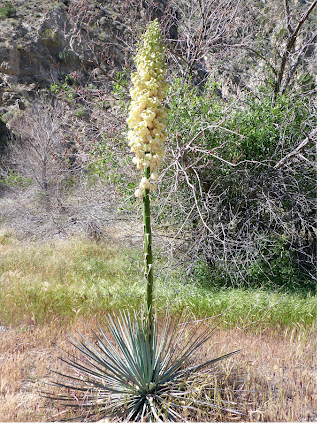
Among the species planted were foothill yucca (Hesperoyucca whipplei), California buckwheat (Eriogonum fasciculatum), narrowleaf milkweed (Asclepias fascicularis), white sage (Salvia apiana), and giant evening primrose (Oenothera elata). Full plant lists for our three farm sites can be seen here.
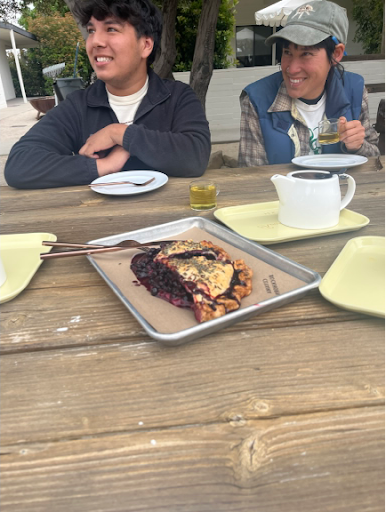
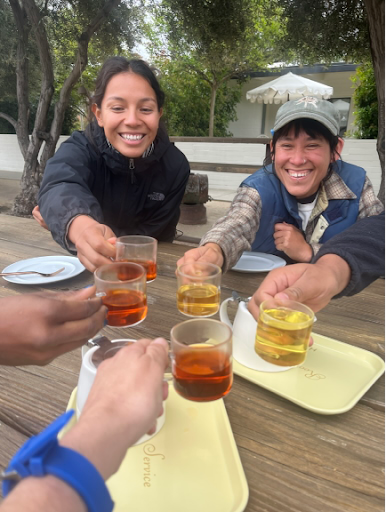
To celebrate the completion of planting, project partners gathered at the Buckhorn Hotel and Restaurant over blueberry-lavender pie and handmade tea. It was a chance to reflect on how far we’ve come and talk about what comes next.
Restoration is about more than plants. It’s also about the people who come together to care for a place. These moments of connection are just as important as the work happening in the field.
Watching the Landscape Grow
Planting may be the most exciting day, but restoration unfolds slowly.
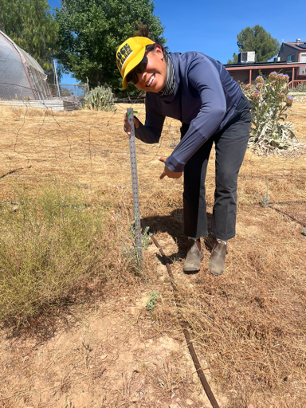
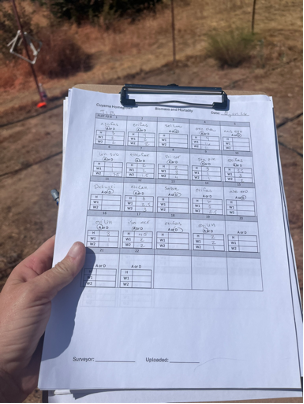
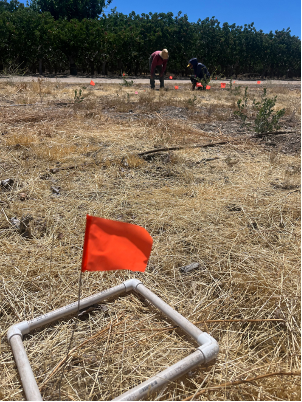
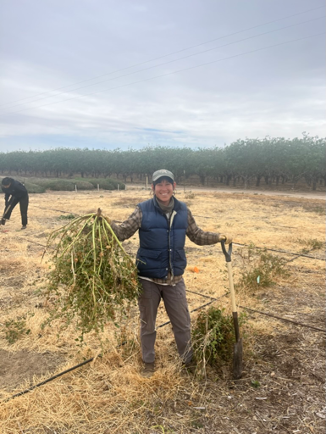
Throughout May and June, staff from Santa Barbara Botanic Garden and Quail Springs returned to each site to check on the new plantings. We measured plant growth, recorded survival, documented which species were spreading naturally from seed, and tracked changes in the surrounding vegetation.
These observations help us understand what is working and where we may need to adjust our approach.
Some species quickly established themselves. California buckwheat, foothill yucca, giant evening primrose, and nodding needlegrass (Stipa cernua) all showed strong survival and growth.
Other species struggled. Fewer than half of the milkweeds- both narrowleaf milkweed (Asclepias fascicularis) and desert milkweed (Asclepias erosa)- survived their first few months after planting.
This is one of the realities of restoration. Every species responds differently to weather, soils, wildlife, and competition. Some flourish immediately, while others take years to establish. Monitoring allows us to learn alongside the landscape and adapt as conditions change.
When Nature Has Other Plans
Not everything this season went according to plan.
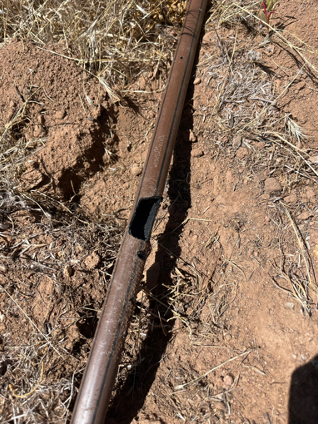
We expected to spend time repairing irrigation lines chewed by curious ground squirrels and gophers. We anticipated pulling weeds after spring rains. What we didn’t expect was a wildfire.
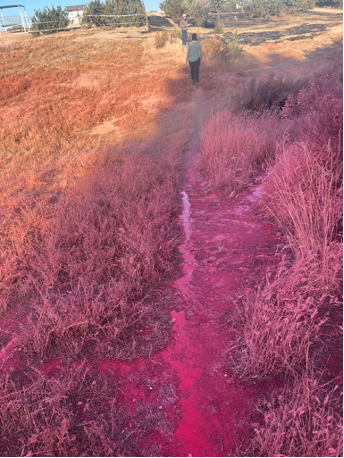
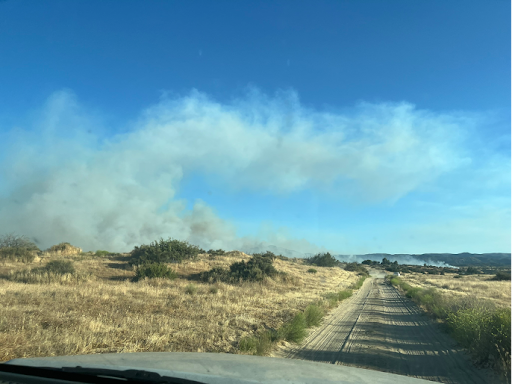
In May, the Foothill Fire burned nearly 1,000 acres in the Cuyama Valley and came dangerously close to one of our partner sites at Cuyama Homegrown.
The fire started near the farm and home of our collaborator, Jean. Members of the Garden and Quail Springs teams helped check on the property and ensure that animals were safe.
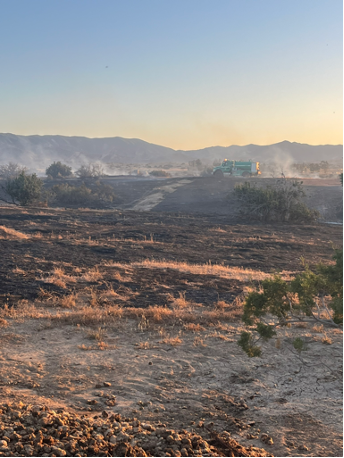
Thanks to the efforts of firefighters, aerial retardant drops, and a fortunate shift in wind patterns, Jean’s home and farm were spared. The flames reached the edge of the restoration habitat, but the site itself survived.
Not everything was so fortunate. Many mature juniper trees on the property and neighboring lands were lost.
Wildfires have always been part of California’s landscapes. Moments like these remind us that restoration does not happen in a controlled environment. It unfolds within living, changing ecosystems shaped by drought, storms, wildlife, and fire.
Success is not about creating something permanent. It is about helping landscapes and communities become resilient enough to recover, adapt, and continue moving forward.
A Season of Steady Progress
This season wasn’t defined by one dramatic moment. Instead, it was shaped by many small things: finishing a planting, measuring new growth, sharing tea with partners, repairing irrigation lines, pulling weeds, and supporting neighbors during a wildfire.
Restoration is slow work. It unfolds over seasons and years rather than days and weeks. The changes are often subtle, but they add up.
Each visit to the field brings new growth, new lessons, and new reasons to be hopeful.
And occasionally, a slice of blueberry-lavender pie.
Together We Can Grow
The Garden couldn’t do this work without the support of the Cuyama Valley community and our incredible partners, including the USDA’s Natural Resources Conservation Service (NRCS)*, Quail Springs, the Cuyama Valley Family Resource Center, Cuyama Joint Unified School District, local farmers, and Cuyama Buckhorn restaurant.
*In accordance with Federal civil rights law and U.S. Department of Agriculture (USDA) civil rights regulations and policies, the USDA, its Agencies, offices, and employees, and institutions participating in or administering USDA programs are prohibited from discriminating based on race, color, national origin, religion, sex, gender identity (including gender expression), sexual orientation, disability, age, marital status, family/parental status, income derived from a public assistance program, political beliefs, or reprisal or retaliation for prior civil rights activity, in any program or activity conducted or funded by USDA (not all bases apply to all programs). Remedies and complaint filing deadlines vary by program or incident.
Persons with disabilities who require alternative means of communication for program information (e.g., Braille, large print, audiotape, American Sign Language, etc.) should contact the responsible Agency or USDA’s TARGET Center at (202) 720-2600 (voice and TTY) or contact USDA through the Federal Relay Service at (800) 877-8339. Additionally, program information may be made available in languages other than English. To file a program discrimination complaint, complete the USDA Program Discrimination Complaint Form, AD-3027, found online at How to File a Program Discrimination Complaint and at any USDA office or write a letter addressed to USDA and provide in the letter all of the information requested in the form. To request a copy of the complaint form, call (866) 632-9992. Submit your completed form or letter to USDA by: (1) mail: U.S. Department of Agriculture, Office of the Assistant Secretary for Civil Rights, 1400 Independence Avenue, SW, Washington, D.C. 20250-9410; (2) fax: (202) 690-7442; or (3) email: program.intake@usda.gov.
USDA is an equal opportunity provider, employer, and lender.
In the Nick of Time: Serendipitous Seed Collection During Fire Season
The Science Behind It All
Putting Pollinators First Through Art: A New Way to Design Gardens
What the Torrey Pines Are Trying to Teach Us