Donate
Not All Plants Burn the Same: Inside Our Fire Safety Research
Combustion Testing recommends Low Flammability, Waterwise Native Taxa for Defensible Space Landscaping.
Throughout my Ph.D., I pursued questions about plant flammability, guided by the philosophy that more information will lead to improved safety outcomes and help us move towards a future where native ecology complements fire protection. With my start as the Garden’s Fire Scientist and with the support of the Saratoga Horticultural Research Endowment, we are excited to announce the start of laboratory combustion testing at the Garden.
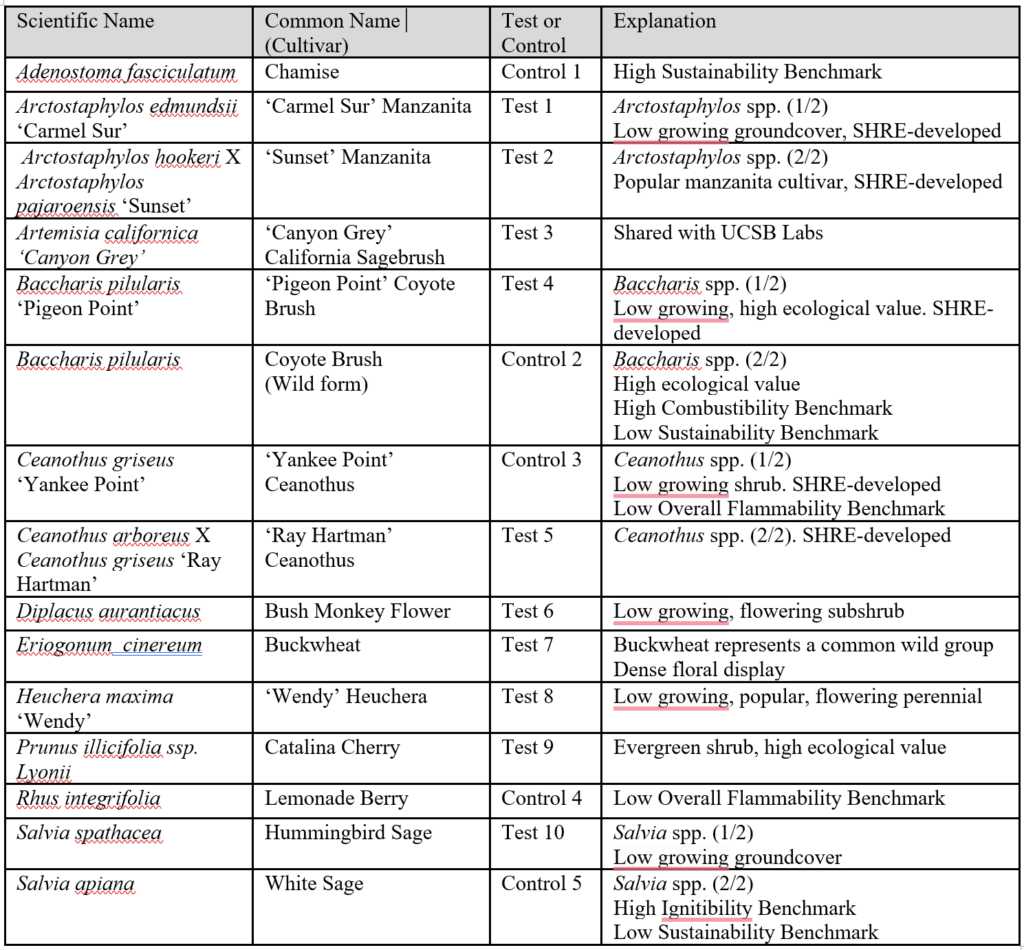
Over the next 12 months, we will be growing 150+ plants across 10 waterwise, native candidate species (and five control species) for defensible-space landscaping. Then, we will build a combustion chamber based on the design engineered through my Ph.D. and burn samples from each plant to compare the candidate species’ flammability. Results will inform recommendations of low-flammability, waterwise, native plants to the horticultural industry.
What is flammability?
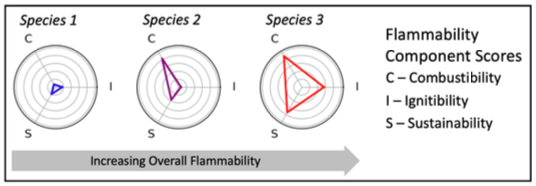
Flammability can be broken into components. That is to say, when you think about how plants burn and fire hazards, you’re probably thinking about multiple things. We break flammability into three components:
- Ignitability: How easily does a plant catch fire? (% autoignition)
- Combustibility: How intensely does a plant burn? (flame height)
- Sustainability: How long does a plant sustain combustion? (flame duration)
Different plants can have different expressions of each of the three components and different overall flammability. The balance among ignitability, combustibility, and sustainability primarily affects a plant’s potential hazard in landscaping.
Why do we need combustion testing?
We need science to back up guidance. Horticultural professionals, policymakers, and local governments lack science-backed guidance for selecting plants with respect to flammability. Existing ‘firewise’ and prohibited plant recommendation lists have documented issues, including: conflicting guidance, invasive species, recommendations without context of growth habits or irrigation needs, and a lack of scientific backing.
Not all plants burn the same. Misperceptions of California’s native plants as fire-hazardous lead some gardeners to resist using native species in defensible-space landscaping. However, California-native plants exhibit a wide range of flammability, with many demonstrating low flammability. The purpose of this study is to identify low-flammability, waterwise native species and remove roadblocks for the usage of these native species in landscaping defensible space. To do this, ten previously untested native taxa and five control taxa (chosen from previously tested species to represent high and low flammability benchmarks) will be burned under the same methods and their flammability performance will be compared.
Waterwise designation does not imply low flammability. Plants may have confounding traits that increase flammability (i.e. store highly flammable chemicals), while others may be low flammability. This study starts with 10 designated waterwise species and will compare flammability performance to the prescribed irrigation needs of all 15 species tested.
What species are being tested?
Getting the word out
Results of the study will be promoted through educational classes, such as the Garden’s 1.5-hour homeowner class and the Garden’s half-day landscaper class (presented in collaboration with the Santa Barbara County Fire Safe Council). The homeowner class will highlight low-flammability, waterwise native species, and their advantages in home landscaping. The professional landscaper class will have a greater focus on seasonal maintenance techniques and design for fire resilience, and go into greater detail on their cultivation and the decision process for selecting low-flammability native plant palettes.
Additionally, findings on particularly promising plants will be promoted through direct communication to horticultural professionals (e.g., nursery managers, retail partners, certified landscape professionals) within the Garden’s network of partner organizations and to the Southern California chapter of the American Society of Landscape Architects.
We’ll also be sharing this research with Garden Members, so stay posted for updates! We will host a demonstration of the combustion chamber and hold public talks highlighting this work starting in fall 2026. Once dates are announced, they will be posted on the Garden’s calendar here.
In the Nick of Time: Serendipitous Seed Collection During Fire Season
The Science Behind It All
Putting Pollinators First Through Art: A New Way to Design Gardens
What the Torrey Pines Are Trying to Teach Us