Donate
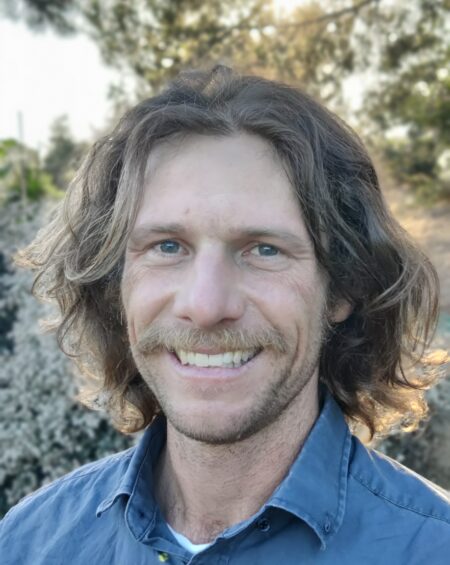
Scot Pipkin
Scot oversees educational programs, spanning school field trips, interpretation, digital education, and community classes/tours.
As director of education, Scot Pipkin oversees Santa Barbara Botanic Garden’s educational programs, spanning school field trips, interpretation, digital education, and community classes/tours. He was born and raised in San Diego, where he fell in love with California’s chaparral and other plant communities. After graduating from the University of California, Los Angeles, with a bachelor’s degree in geography and an emphasis in biogeography, Scot worked to share his love for the natural world across the Southwest region. This work included providing environmental education to elementary students, training volunteers to participate in research projects, developing management plans, and developing regional educational efforts. Along the way, he also earned a master’s degree in landscape architecture from the University of Arizona.
Insights
-
Supporting Pollinators and Local Wildlife with Native Plants
Native plants provide the foundation for all life on Earth – serving as the anchor points of global food webs. They are essential to the health and wellbeing of our pollinators, wildlife – and even you and me. Insects such as bees, wasps, butterflies, and beetles play critical roles as pollinators, seed dispersers, and natural pest controllers. If you enjoy a colorful salad or a…
-
Layers of Habitat
Garden Design To Support the Web of Life Part 1: Design for Wildlife and Beauty With Layers Some of the most diverse and interesting habitat gardens I encounter use habitat layers, massing, and strategic plant palettes to great effect. Ecologically, building three-dimensional (3D) structures in our gardens helps us support the web of life. Aesthetically,…
-
Three Reasons Native Plants Are Essential
It is difficult to overstate how important plants are to our existence. Their ability to turn the sun’s energy, water, and carbon dioxide into sugar and oxygen is what makes plants one of Earth’s most precious resources. This life-giving power of plants is one of the fundamental reasons why gardening is such a quintessentially human…
-
My Talk with Botanist and Illustrator Linda Vorobik, Ph.D.
Linda Ann Vorobik, Ph.D. is a botanist, botanical illustrator, and frequent collaborator with Santa Barbara Botanic Garden. At the Garden, we feel lucky to have her support as both a professional illustrator providing technical illustrations for the Garden’s floristics (including the forthcoming, comprehensive flora of all eight California Channel Islands) and an instructor providing guidance…
-
After the Rains: California’s Rain Season
The 2023 rainy season has been marked by a series of atmospheric rivers that have brought abundant moisture to California. With this, the Garden experienced its strongest rainfall event of the season on January 9, receiving 9.48” according to the Garden’s Remote Automatic Weather Station. This precipitation event brought down several mature coast live oak…
-
Another Way to Listen: Forest Bathing and Nature Connection
I’ve been told tales of people who can hear things in nature that most of us would call “silent.” It’s not just that they have acute hearing and are capable of registering very low decibel levels. It’s a skill that gets developed through deep observation of the natural world and time spent opening oneself to…
-
Winter Birds and Where to Find Them
In southern California, the shift between seasons can be to which birds are and are not present in our yards, Gardens, subtle. With freezing temperatures and snow limited to and open spaces, we can build our seasonal fluency in southern high elevations and an abundance of evergreen trees/shrubs California. For much of North America, winter…
-
Nature Educators Provide Transformative Experiences
The Santa Barbara Botanic Garden is constantly renewing its commitment to connecting people with the remarkable native flora of California and specifically the Central Coast. Mounting evidence over the last decade indicates that young people spend less time learning from the natural world, lowering overall environmental literacy and our communal sense of connection to nature.…