Donate
Introducing the 805 Initiative: Santa Barbara Botanic Garden’s Local Genetics Nursery Program
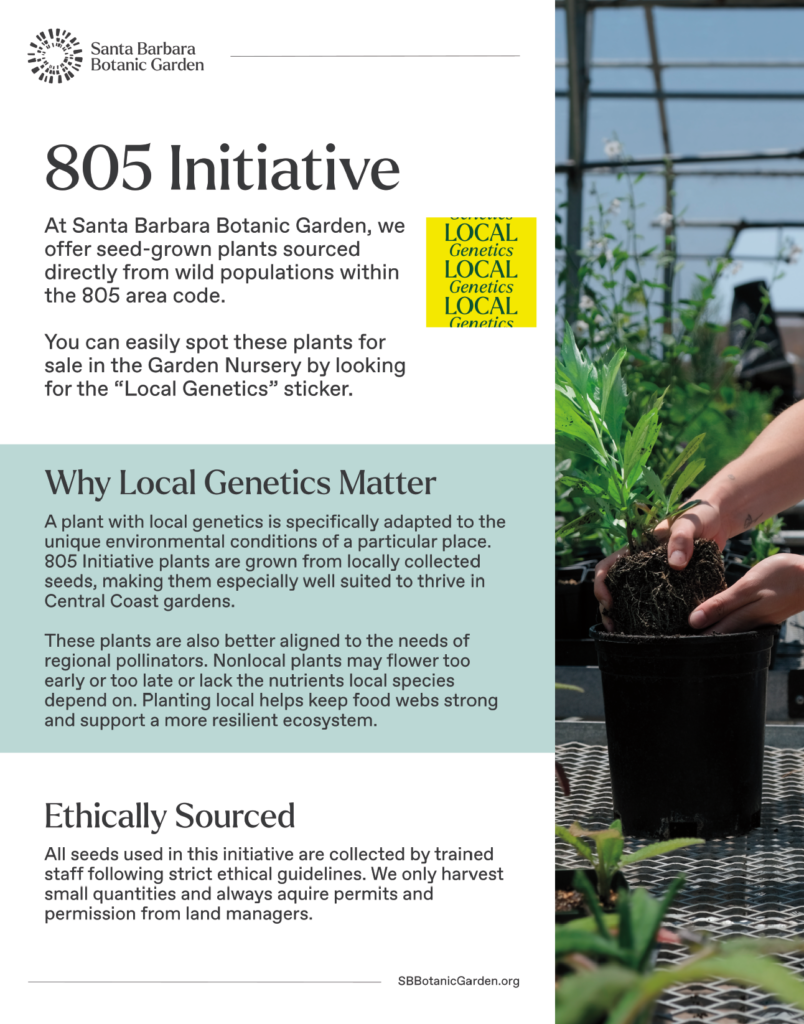
Last year, Santa Barbara Botanic Garden introduced a new nursery initiative designed to produce locally adapted plant material for restoring wildlands and for anyone wanting to support wildlife with regionally endemic native plants. We call this program our 805 Initiative, named for our area code, which stretches along the South and Central Coast of California, from Ventura County and the northern Channel Islands, proceeding north through San Luis Obispo and into southern Monterey County. Although this area spans approximately 200 miles along California’s Coast, our efforts are concentrated in and around the Garden, where staff and volunteers ethically harvest seeds from accessioned plants in our Living Collection or from permitted local properties. From seed collection and cleaning, the newly launched 805 Initiative plants are sown and grown by our Nursery Propagation team and volunteers until they are ready for transfer to our Retail Nursery, where they are marked with stickers highlighting them as “local natives” and “805 plants.”
Why are local natives important?
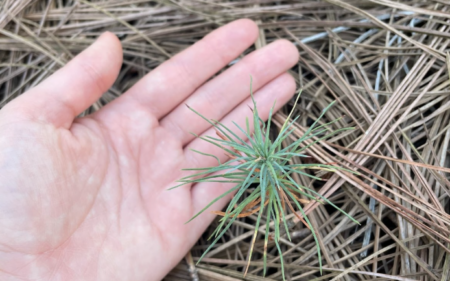
The Garden curates a living collection comprised of 1,000+ plant species found across the state, all part of the California Floristic Province. However, locally native plants provide the best ecological resources for native wildlife because they are adapted to our local climate and environment. Here at the Garden, our teams continue to study and document plants that produce abundant resources for pollinators, songbirds, mammals, and other wildlife, so we can recommend keystone species that all gardeners should strive to make space for in their landscapes. One recent trial highlighting the importance of locally adapted seed was discovered by our nursery team. They sowed foothill needlegrass (Stipa lepida) from three different sourced populations for our climate-forward landscape transformation project at Elings Park. Seed for the project was procured from collected populations in San Diego, Los Angeles, and Santa Barbara. Most likely due to genetic adaptations present in the different seeds, the San Diego population germinated first, a full week ahead of the Los Angeles seed lot, which itself came up 1 week ahead of the Santa Barbara seeds. Foothill needlegrass supports populations of a few skipper and butterfly species, so aligning the timing of emerging lepidopteran caterpillars (butterflies, moths, and skippers) with plant growth and flowering is important to provide the best opportunity for native wildlife to access plant resources that they’ve evolved to rely on.
The 805 Initiative, at its heart, aims to provide community members with an important resource and appropriate plant option for those living at the wildland-urban interface or those wanting to support wildlife with the most adapted genetic material. With numerous pressures on our environment from continued human development, wildfire, and extractive industries, access to local plant material from identified ecosystems provides the public with one additional tool to help mitigate the destruction of habitat resulting from genetic inbreeding or localized extirpation of plant populations. With more interest in native plants than ever before, the 805 Initiative offers customers hope in creating the best possible habitat garden to support pollinators and other wildlife.
Beyond our retail efforts, the Garden recently added an 805 section along the trail leading to the Pritzlaff Conservation Center. In this location, you will find a concentration of 805 plants enhancing an existing chaparral habitat with an understory of hummingbird sage (Salvia spathacea), blue eyed grass (Sisyrinchium bellum), Douglas’ nightshade (Solanum douglasii), climbing penstemon (Keckiella cordifolia), and other plants. Installing these plants amid greenbark ceanothus (Ceanothus spinosus), laurel sumac (Malosma laurina), lemonade berry (Rhus integrifolia), and other shrubs will provide maximum habitat for critters that inhabit chaparral landscapes, along with transient wildlife visitors like migrating songbirds and pollinators.
Learn More and Purchase 805 Initiative Plants
For those wanting to support wildlife and celebrate this region’s sense of place, we encourage you to add more 805 initiative plants to your garden. Selecting the right species for your habitat garden is a great way to support biodiversity and to achieve the Garden’s suggestion of dedicating at least 30% of your landscape to native plants. Choosing locally adapted plants for your landscape is also a great way to become a native plant steward and support the Native Plant Movement. 805 plants are available for purchase year-round in our Nursery, just look for the 805 and Local Natives stickers, or ask a friendly sales associate for assistance.
Funding for the 805 Initiative was generously provided by the Artemisia Fund.
In the Nick of Time: Serendipitous Seed Collection During Fire Season
The Science Behind It All
Putting Pollinators First Through Art: A New Way to Design Gardens
What the Torrey Pines Are Trying to Teach Us